Empire of Pain
A reflection on Empire of Pain, the Sackler family's pursuit of success, and the uncomfortable questions it raises about ambition, wealth, responsibility, and self-deception.
When Success Becomes the Wrong Measure
I recently finished listening to Empire of Pain, Patrick Radden Keefe’s account of the Sackler family, Purdue Pharma, and the devastating consequences of OxyContin. It’s an exceptionally well-written book, engaging in a way that nonfiction sometimes struggles to be. But what has stayed with me most isn’t simply the tragedy of what happened. It’s the question of what motivated the people involved, how they justified their decisions, and what their story might reveal about my own motivations.
Arthur Sackler, the eldest of the three brothers, possessed many qualities I admire. He was intelligent, innovative, hardworking, entrepreneurial, and willing to bet on himself. Early in his career, he seemed genuinely interested in finding more humane ways to treat psychiatric patients through medication. He also recognized opportunities others overlooked, made strategic investments, and became extraordinarily successful.
But his innovations in pharmaceutical marketing helped establish practices that later generations of the family would employ in aggressively promoting OxyContin. Arthur died before OxyContin was introduced, but his influence on the industry endured.
At what point did the desire to help people become secondary to the desire for financial success? Did his motivations change, or were they always mixed? And perhaps more troubling, is it possible that he never believed he had abandoned his original intentions?
One of the most disturbing aspects of the book is the Sackler family’s persistent resistance to acknowledging responsibility for the damage caused by OxyContin. There were always explanations. Other people prescribed the medication. Other people misused it. Other factors contributed to addiction. Some of those observations may be true in isolation, but they don’t erase the responsibility of a company that aggressively promoted a medication while downplaying its risks.
It’s tempting to look at the Sacklers and conclude that I would never behave as they did. But perhaps the more useful question is how any of us can recognize when our own interests are influencing what we’re willing to believe. How do we guard against convincing ourselves that something is right simply because we want it to be?
As I listened, I began imagining a graph with two independent dimensions: financial success and moral goodness. A person can be wealthy and generous, wealthy and exploitative, poor and generous, or poor and selfish. Wealth isn’t evidence of goodness, and poverty isn’t evidence of failure. We cannot measure one by the other.
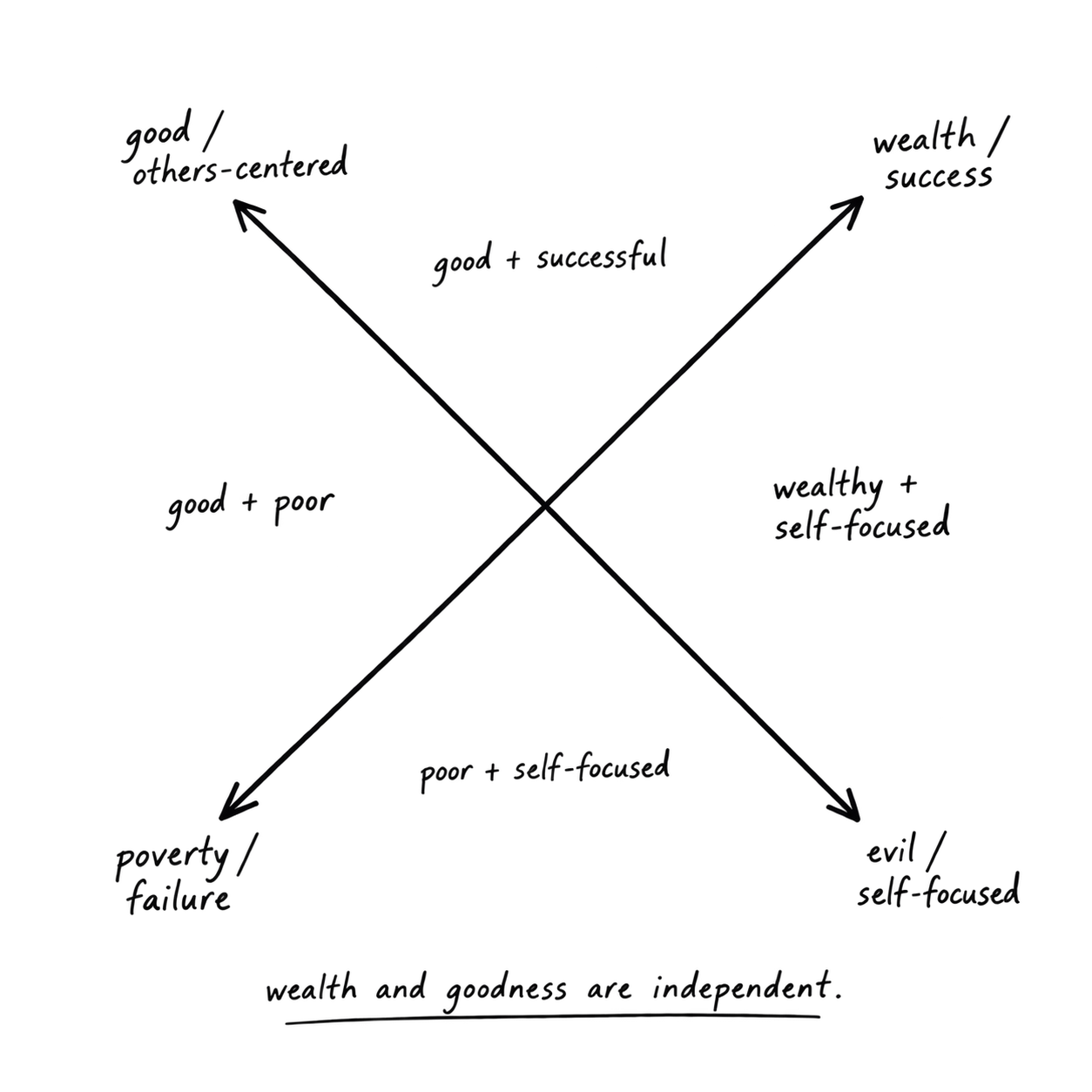
The Sacklers accumulated extraordinary wealth and gave generously to universities, museums, and medical institutions. Those contributions produced real benefits, but do they reconcile the harm associated with how much of their fortune was made? I don’t think so. Generosity is admirable, but giving away money doesn’t necessarily justify how it was acquired.
As a Christian, I believe that everything I have, including my abilities and opportunities, is ultimately entrusted to me by God. I’m called to be generous, to care about others, and to be faithful with what I’ve been given. But I don’t believe that means avoiding ambition or financial success. There is value in excellence, in working hard, in building something useful, and in being appropriately compensated for that work.
The difficulty is knowing when success has stopped being a result of doing good work and has become the objective that justifies everything else.
I think part of the answer is recognizing that financial success is an outcome, not the ultimate purpose. Another part is being willing to acknowledge when my interests and someone else’s don’t align, even when doing so might cost me an opportunity. But those principles still leave me wondering how to recognize when I’m deceiving myself.
I finished Empire of Pain with a great deal of admiration for Keefe’s storytelling and a great deal of sadness over the destruction chronicled in the book. I also finished it with questions I hadn’t expected to be asking about myself.
It’s easy to condemn greed when we see its consequences in someone else’s life. It’s considerably harder to recognize the quieter ways our own desire for success might influence our judgment.
I don’t think ambition is wrong. I don’t think making money is wrong. And I don’t think the existence of mixed motives necessarily makes the good we accomplish meaningless.
But I do think the things we pursue have a way of shaping us.
If wealth is the measure of success, we may eventually find ourselves willing to sacrifice things that matter much more in order to obtain it.
I’d rather measure success by something that doesn’t depend on how much money I make, how much recognition I receive, or how impressive my accomplishments appear.
I haven’t worked out exactly what that looks like in every decision.
But perhaps asking the question, and remaining willing to be challenged by the answer, is a good place to start.