Becoming a Toolmaker
Blacksmithing, a crown molding jig, and using AI to create better ways to make things.
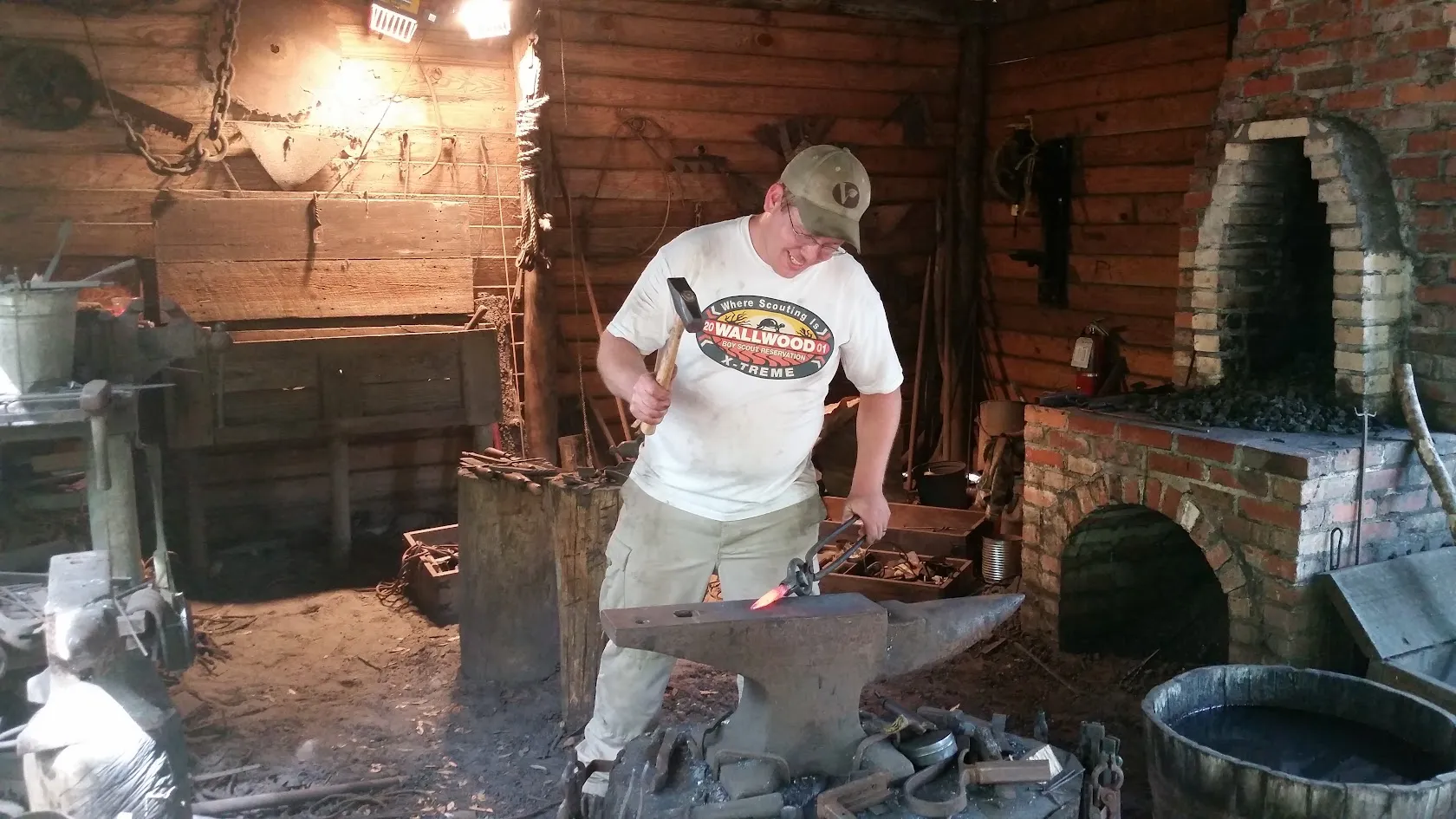
Years ago, someone gave me an old rivet forge. I’ve always enjoyed working with my hands, building things, and figuring out how things work, so I was excited to try my hand at blacksmithing. A few years later, Meagan gave me a blacksmithing class at the Tallahassee Museum for my birthday.
I never became particularly skilled at it. I made a few things, including some Christmas stocking hangers, an S-hook, and a cross formed from a single piece of square steel. At the time, I owned a lawn service and had a supply of worn-out edger blades. I tried turning some of those into other useful objects, without much success.
Sadly, my forge isn’t in working condition today.
But there’s something about blacksmithing that has stuck with me, particularly as I’ve been learning to use artificial intelligence.
A blacksmith doesn’t just use tools. A blacksmith can make tools.
With a forge, an anvil, a hammer, and a few other basic implements, a blacksmith can create a specialized tool for a particular purpose. Need something to grip an unusual shape? Make a pair of tongs. Need a punch, chisel, or bracket? Make one.
The blacksmith isn’t limited to what happens to be available in a toolbox. The ability to make tools becomes a tool in itself.
Sometimes You Build the Tool First
I’ve spent a lot of time over the years remodeling houses. One of the things I’ve learned is that a little preparation can save an enormous amount of frustration.
Take crown molding, for example.
Crown molding sits at an angle between the wall and ceiling. Getting two pieces to meet neatly in a corner can be surprisingly complicated. You can lay the molding flat on a compound miter saw, calculate the necessary angles, and make the cuts. But the geometry can be confusing, and it’s remarkably easy to cut a piece backward, upside down, or at the wrong angle.
Years ago, I made a simple jig to help with this.
The jig held the crown molding against the saw in the same orientation it would have when installed between the wall and ceiling. Instead of trying to visualize how a complicated compound cut would translate to the finished installation, I could see how the molding would fit and make the appropriate miter cut.
It wasn’t elaborate. It didn’t require expensive materials or sophisticated engineering. But it made the work easier to understand, faster to perform, and less prone to mistakes.
The jig wasn’t the thing I was trying to build. I wanted to install crown molding. But spending a little time building the jig first made accomplishing that goal much easier.
The same principle applies on a larger scale. A crane is not the building being constructed. Scaffolding isn’t part of the finished structure. Yet both may be essential to getting the work done.
Sometimes the most productive thing you can do is to build what you need before starting on the finished product.
A Different Way of Thinking About AI
I’ve been spending a lot of time learning how to use AI more effectively, not just as a tool for answering questions or generating content, but as a thought partner, design partner, and development partner.
Recently, I’ve been working on graphics and promotional materials for the Capital Chordsmen, a barbershop chorus where I serve as Vice President of Marketing and Public Relations.
My previous experiences generating images with ChatGPT and Gemini often followed a frustrating pattern. I’d describe what I wanted, and the initial result might be remarkably close. Sometimes I loved 90% of it. But when I tried to change the remaining 10%, the entire design would shift. Elements I liked would disappear or change, and I’d find myself trying to recreate something that had already been almost right.
I’d also used Canva, but my approach was fairly basic. I could find or create individual elements and arrange them, but I didn’t have the design skills to consistently produce the polished results I envisioned.
This time, I approached the problem differently.
Instead of simply asking AI to create a finished image, I started thinking about how the design should be built. I wanted editable elements, layers I could work with independently, and a design I could refine in Canva without rebuilding everything whenever I wanted to change one detail.
I began directing the process, not just describing the desired result.
The difference was substantial. I could create better-looking graphics, assemble them more effectively, and make targeted changes without destroying the parts I already liked. The process was also much faster than trying to do all the design work myself.
That’s when I started thinking about the blacksmith and my crown molding jig.
I wasn’t just using AI to create the finished product. I was using AI to help build a better way to create it.
The Tool Doesn’t Have to Exist Yet
I’ve started applying that same thinking to other kinds of work.
Sometimes, rather than asking ChatGPT to perform a task, I’ll ask it to help me develop the prompt that will accomplish the task. We can discuss the objective, identify what information is needed, anticipate problems, and establish a framework before attempting the work itself.
It’s another way of building the jig before making the cut.
The same approach applies to more complicated projects.
Suppose I want a spreadsheet to analyze a business decision. I can work with AI to determine what information matters, how the calculations should work, and how to present the results.
But perhaps a spreadsheet isn’t the best solution. Maybe I need a database, a custom application, or a repeatable process that combines several tools.
I don’t necessarily have to know how to build those things before I begin. I can explore the options, learn what I need along the way, and work with AI to develop something suited to the problem.
I’ve been doing this in my real estate business, developing tools to organize and analyze property information, investigate potential opportunities, and support acquisition decisions.
Some projects are simple. Others require considerable experimentation, troubleshooting, and refinement. Not every idea works, and not every tool is worth building.
But the possibilities are different when I’m no longer limited to the tools I already know how to use.
A New Kind of Workshop
For most of my life, if I wanted to accomplish something outside my existing skill set, I could learn a new skill, purchase a tool, hire someone with the necessary expertise, or find a workaround.
Those are still good options, and often the right ones.
But AI gives me another possibility. I can explore an unfamiliar problem, work through potential solutions, and begin building something tailored to what I’m trying to accomplish.
In a sense, AI is becoming a workshop where I can design and build tools for the particular problems I encounter.
Some of those tools might be used once and discarded, like temporary scaffolding. Others might become reusable fixtures, like my crown molding jig. Still others might grow into systems that support entirely new ways of working.
Of course, being able to build something doesn’t guarantee that it works. AI can make mistakes, and a tool that produces an impressive result once may not be reliable when repeated. Understanding the problem, testing the work, and knowing when to seek expertise remain essential.
But I find the change in perspective fascinating.
Instead of asking only, “What can I do with the tools I have?” I can also ask, “What tool would make this possible?”
And increasingly, I have the ability to do something about the answer.
Becoming a Toolmaker
I don’t expect to become an expert blacksmith. My old forge may never produce another useful object.
But I’ve come to appreciate the mindset of a craftsman who can make his own tools.
I don’t need to become an expert programmer, graphic designer, or data analyst to begin exploring problems that involve those disciplines. I still need to understand what I’m trying to accomplish, learn enough to evaluate the work, and recognize the limits of my own knowledge. But I can attempt things that would have been impractical for me not very long ago.
That’s what excites me most about AI.
Not simply that it can write an article, generate a picture, or answer a question, although those capabilities are useful. It’s that I can use it to develop ideas, create tools, and expand what I’m capable of doing.
I started learning blacksmithing because I liked the idea of making things.
What I find exciting today is discovering that I can also make the tools that help me make things.
And I’m only beginning to explore what that makes possible.